Consider the modern consumer devices hitting the market today: smartwatches measuring blood oxygen levels or wireless earbuds featuring adaptive noise cancellation. While these innovations feel like sudden “eureka” moments from a top-secret lab, the path from initial concept to commercial product is rarely spontaneous.
But from a technological and corporate strategy standpoint, the path to these innovations is carefully calculated. So, how do R&D teams actually decide what to build next? The reality of how engineering intersects with intellectual property (IP) is far more strategic than throwing ideas at a whiteboard.
Key Takeaways
- Beyond the “Eureka” Myth: Breakthrough product features stem from structured analytics rather than random brainstorming sessions.
- Overcoming the 18-Month Blind Spot: Combining non-patent disclosures with global filing trends helps teams detect hidden competitor moves early.
- Accelerating Open Innovation: Patent data acts as a discovery engine for external tech partnerships, licensing, and startup acquisitions.
- Offense vs. Defense: IP is not just a defensive shield made of legalese; high-volume patent filings are aggressively leveraged as major brand differentiators to establish dominance in both hardware utilities and software ecosystems.
- Global Blindspots: A flawless R&D strategy can fail if it ignores cross-jurisdictional borders. Missing a single unmonitored filing in the USPTO, EPO, or JPO can result in unforeseen competitive threats.
World’s Largest Technology Library
To understand the IP dynamics at play, organizations must shift from a purely risk-mitigation mindset to include a strategic enterprise asset mindset, as well.
While patents are often viewed merely as tools for legal protection, patent databases are actually the world’s most comprehensive repositories of public technical disclosures. For R&D teams, they serve as a source of actionable intelligence offering verified technical blueprints long before products hit the market.
True R&D Strategy: White Space, FTO, and Trends
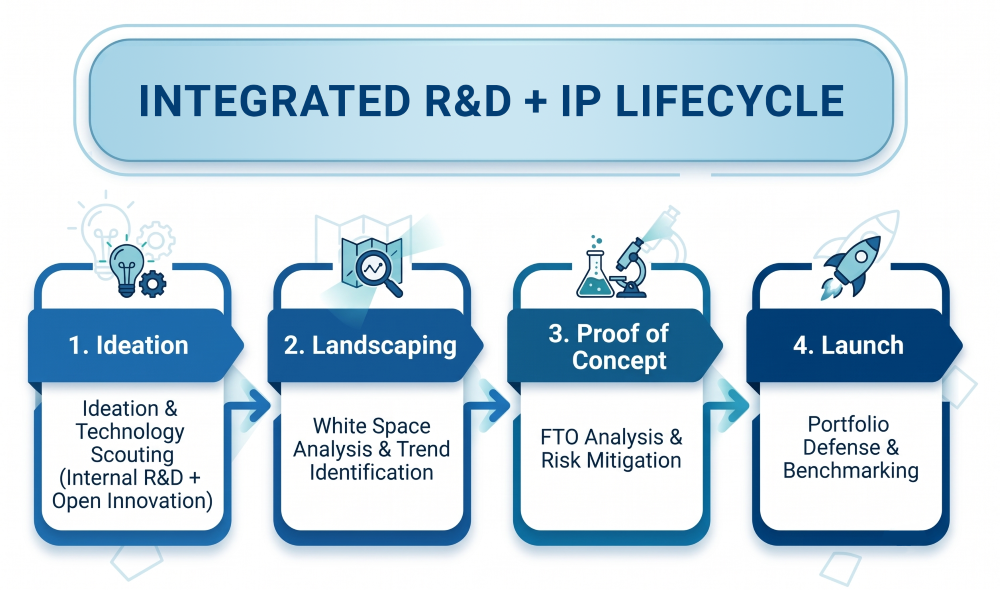
The real innovation in R&D planning lies in how this data is organized and analyzed. Consider a team developing a new wearable health sensor. They do not just start building; they look at the landscape.
Today’s patent analytics tools employ machine learning that understands semantic structures, technical classifications, and global filing behaviors to give R&D teams exact insights within seconds. All these predictive dashboards and landscape models serve multiple critical functions.
Spotting the White Space
Imagine trying to improve battery thermal management for a new consumer device. Analytics will show exactly what your competitors have already locked down. More importantly, it highlights the “white space” the technological gaps where nobody has yet filed anything. It directs the R&D team to where the actual opportunity is, ensuring they invest research funds into areas with high innovation potential.
Ensuring Freedom to Operate (FTO)
Then there is the matter of risk mitigation. There is nothing worse than an R&D team spending two years and millions of dollars developing a brilliant new predictive algorithm, only to find out a tech giant patented the core concept three years ago. Patent analytics provides Freedom to Operate (FTO) insights, preventing teams from reinventing the wheel and keeping the company out of court.
Predictive Intelligence
Developing a way for an R&D team to intuitively “remember” competitor trajectories and instantly pivot their own development requires deep data integration. The analytical tools manage search efficiency and personalized ranking systems to track competitors over time so a patent analyst can flag this trend immediately.
Bridging the 18-Month Blind Spot Gap
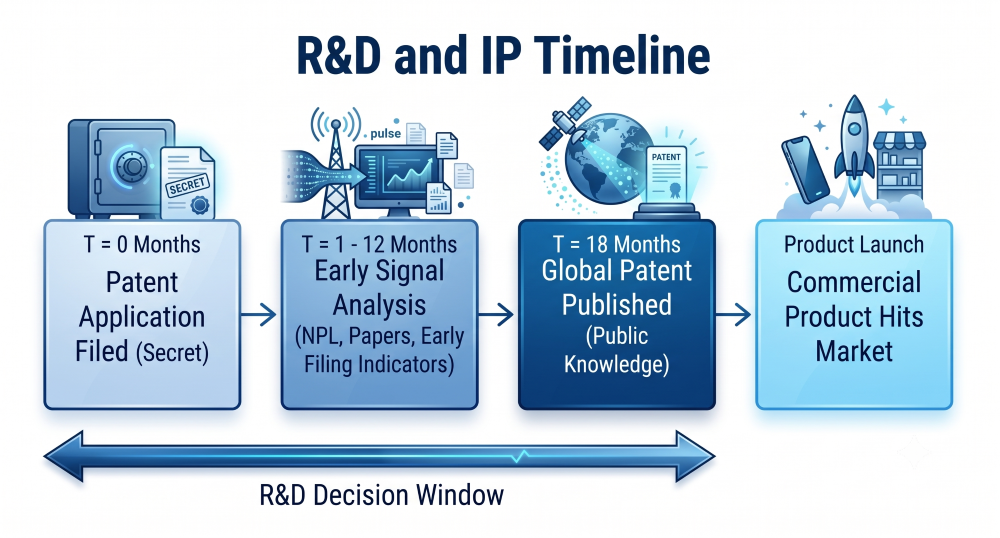
While patents offer incredible technological visibility, they inherently come with a challenge: the 18-month publication delay. By the time a patent application is publicly disclosed, the applicant may already be far along in their development cycle.
To bridge this gap, leading R&D organizations rely on hybrid intelligence. By correlating patent family filings across international offices (such as the USPTO, EPO, and JPO) with non-patent literature (NPL) including scientific publications, early-stage research papers, and technical conference disclosures, analytics teams can detect early indicators of innovation long before the 18-month window closes.
Core Strategic Functions in Action
| Strategic Function | Core Objective | Impact on R&D |
| White Space Analysis | Unclaimed technical gaps & open domains. | Direct research spends toward areas with the highest innovation potential. |
| Freedom to Operate (FTO) | Active third-party patents & claim scopes. | Prevents expensive redesigns, litigation, and market entry delays. |
| Predictive Intelligence | Competitor filing velocity & technology shifts. | Enables proactive R&D shifts based on competitor trajectories. |
| Tech Scouting & Open Innovation | Startup portfolios, university assignees, & citation clusters | Informs “Make vs. Buy vs. Partner” decisions to accelerate time-to-market |
| Competitive Benchmarking | Patent volume, strength, & regional coverage. | Protects market share and measures R&D output against peers. |
Expanding Horizons: Open Innovation & Tech Scouting
Relying exclusively on internal research facilities is no longer practical in fast-moving industries. Forward-thinking enterprises increasingly lean on Open Innovation, reaching beyond company walls to identify external technological breakthroughs, collaborative partners, and early-stage ventures.
Patent analytics functions as a radar for this broader innovation landscape. By examining citation networks, academic filings, and niche startup disclosures, technology leaders gain early visibility into emerging technology creators. This data allows leadership to evaluate whether to build a solution in-house, acquire an established team, or license external IP, saving time and preventing redundant development efforts.
The Competitive Benchmark Angle: Protecting Market Share
While navigating legal risks covers the defensive side, patent analytics is also a major offensive tool. The sheer volume of patents a company files in a specific domain is a major brand differentiator. Because of this, enterprises heavily utilize landscape reports to safeguard their position and benchmark their R&D output against industry leaders.
To successfully dominate a technology sector, an enterprise must defend both its backend hardware (via core utility patents) and its unique software ecosystems. Analytics allows them to see exactly where they rank against competitors, creating a multi-pronged IP battlefield.
Cross-Jurisdictional Complexity of Global Innovation
Technology is a borderless, global language, and hence analyzing the IP cannot be confined to a single market. Modern consumer technology needs to be flawless across various regions, and thus, an enterprise will have to monitor and enforce its patents in multiple international regions at once, including the USPTO, EPO, and JPO.
Monitoring patent family correspondences, complying with the various national requirements for patenting tech innovations, and translating foreign-language filings is no easy task. Large tech brands could miss a critical competitive threat due to a single unmonitored filing in another country.
To eliminate these global blind spots, enterprise analytics platforms leverage cross-border patent family mapping and automated jurisdictional tracking. By unifying global patent office feeds into a synchronized alert system, R&D teams gain real-time visibility into equivalent filings worldwide, ensuring no critical competitor maneuver goes unnoticed regardless of language or filing jurisdiction.
Turning Everyday Data into Enterprise Asset Strategy
The next time you are unboxing a sleek new device, remember: the seamless features we are enjoying are the result of a massive, strategically mapped web of R&D and IP intelligence.
In a hyper-competitive tech market, managing an R&D budget that spans standard-essential technologies, hardware utilities, and software patents is a massive undertaking. Enterprises must actively monitor competitor filings, navigate white spaces, and ensure seamless innovation management.
At MaxVal, we help innovative organizations transform complex R&D breakthroughs into strategically and financially valuable assets. Through our expert-led Patent Search and Analytics services, we give legal and engineering teams the precise insights they need to mitigate risk when launching products, spot market trends, and manage global portfolios with complete confidence.
Simplify your technology and software patent management. Let MaxVal’s IP experts optimize your portfolio from end to end.