A Strategic Deep-Dive into 14,152 3GPP Release 20 Contributions Across AI/ML, ISAC, NTN, and Ambient IoT
As the telecommunications ecosystem accelerates toward next-generation connectivity, 3GPP standardization activity has reached unprecedented velocity. Between January 2025 and October 2026, global vendors, operators, and research institutes logged 14,152 technical document submissions. A quantitative analysis of this dataset provides an unprecedented look at who is steering 6G architecture, which technical pillars dominate the agenda, and how companies navigate standard-setting under geopolitical constraints.
6G Standardization Landscape: Key Players, Contributions, and Technology Trends
1. Overall Landscape & Working Group Dynamics
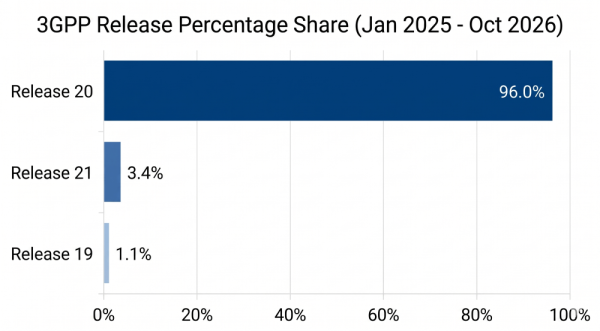
Standardization momentum is overwhelmingly centered on Release 20, which acts as the core architectural gateway to 6G specifications.
2. Working Group Focus: Architecture Over Radio

Work is heavily concentrated in Service and System Aspects (SA) working groups: notably SA2 (Architecture: 5,927 docs / ~41.9%) and SA1 (Services & Requirements: 3,084 docs / ~21.8%), rather than physical layer radio groups. This indicates 6G Standardization is currently in its functional and architectural definition phase, establishing network framework baselines prior to physical-layer radio specification locking.
3. Leaderboards: Submissions Volume vs. Approved Consensus
While submission volume reflects aggressive R&D bandwidth aimed at staking broad defensive claims, approved documents reveal where true multi-party consensus and patent enforceability lie. This gap exposes two distinct corporate playbooks: an aggregative land-grab strategy that floods working groups to maximize baseline patent declarations, and a targeted precision strategy that converts fewer, high-consensus proposals into locked specifications.
For licensing executives, this dynamic demonstrates that proposal volume alone will not dictate 6G market power; true standard-essential leverage is concentrated among players who successfully navigate consortium politics to shape finalized, enforceable standards.

4. Comprehensive 4-Pillar Technology Matrix
Examining submissions across the four foundational technological battlegrounds of 6G Standardization reveals distinct regional and company leadership dynamics:
To evaluate this landscape effectively, we distinguish between two critical measures:
- Top Volume / Approved Leaders reflects absolute presence, highlighting the companies driving the largest share of submitted and agreed-upon specifications.
- In contrast, Conversion Leader measures surgical efficiency, identifying organizations with the highest win rate of successfully steering their proposals through technical debate into finalized, approved standards.
| Technology Pillar | Total Docs (Share of 6G Activity %) |
Approved Docs | Top Volume / Approved Leaders | Conversion Leader |
|---|---|---|---|---|
| AI/ML Native Network | 6,610 (46.7%) | 592 | Huawei (26.4%) & China Mobile (25.8%) | Ericsson (19.7%) |
| ISAC (Integrated Sensing) | 1,716 (12.1%) | 154 | Huawei (21.4%) & China Mobile/ZTE (16.9%) | KPN Telecom (22.6%) & Ericsson (19.2%) |
| NTN (Satellite / Direct-to-Cell) | 1,750 (12.4%) | 131 | Ericsson (14.5%) & AT&T (13.0%) | Ericsson (22.6%) |
| Ambient IoT (Zero-Energy) | 259 (1.8%) | 6 | China Mobile, Ericsson, Sony (2 docs / 33.3% each) | Ericsson (11.1%), Sony (7.1%), China Mobile (6.9%) |
3GPP Release 20 analysis Key Strategic Insights & Analytical Takeaways
- AI/ML is the Primary Engine of 6G (46.7% of all work): Nearly half of all 3GPP 6G contributions involve AI/ML functional frameworks, NWDAF analytics, and generative model management. Huawei (156 approved) and China Mobile (153 approved) command a duopoly, capturing 52.2% of all approved AI/ML standards combined.
- Western Players Reclaim Ground in NTN Direct-to-Cell: Non-Terrestrial Networks (NTN) showcase a clear shift toward Western vendors and operators. Ericsson leads approved NTN specifications (19 approved / 14.5% share), while US tier-1 operator AT&T ranks #2 (17 approved / 13.0% share), driven by intense commercial demand for satellite-to-phone coverage. Aerospace leaders like Thales and Airbus also feature prominently.
- Volume Land-Grab vs. Approval Conversion Efficiency: A sharp strategic divergence exists between market participants:
- High-Volume Strategy: Asian leaders (Huawei, China Mobile, ZTE) flood 3GPP working groups with thousands of technical proposals to maximize early Standard Essential Patent (SEP) exposure.
- Precision Efficiency Strategy: Western vendors like Ericsson demonstrate industry-leading approval conversion efficiency, converting 19.7% of its AI/ML papers, 19.2% of its ISAC papers, and 22.6% of its NTN papers into officially approved standards.
- The SEP Licensing Paradox Under Market Restrictions: Despite geopolitical export controls and market bans in Western infrastructure markets, restricted Chinese vendors continue to lock in core SEP IP by dominating global 3GPP System Architecture and AI specifications. Consequently, Western operators deploying standard-compliant 6G networks will ultimately be required to license underlying patents held by vendors whose physical hardware they are legally restricted from purchasing.
- Ambient IoT as the Frontier Battleground: While representing under 2% of current activity, battery-free IoT features a uniquely diversified ecosystem spanning network vendors, telecom operators, and consumer electronics giants (Oppo, Sony, Qualcomm, MediaTek).
How MaxVal supports 6G patent analytics and SEP strategy
- 3GPP Contribution & Standards Tracking: Continuously monitor TDocs, Work Items, and Study Items across SA and RAN working groups to benchmark competitive momentum and approval ratios.
- SEP Identification & Essentiality Checks: Map declared and emerging patents directly to approved 3GPP Release 20 specifications (AI/ML, ISAC, NTN, Ambient IoT) to verify true standard essentiality.
- FRAND Licensing & Royalty Benchmarking: Model portfolio strength, evaluate peer conversion rates, and suggest prospective cross-licensing negotiations and pool targets.
- Portfolio Pruning & Strategic Filing: Identify white spaces in early-stage 6G domains to optimize prosecution budgets and align filings with consensus-backed standards.
- Litigation Defense & Prior Art Discovery: Uncover multi-jurisdictional non-patent literature and early working group contributions to invalidate asserted patents or defend against injunctions.
Know Where You Stand in the 6G Patent Race.
MaxVal tracks 3GPP contributions, checks SEP essentiality, and benchmarks your portfolio against competitors.