Imagine a market completely free of cutthroat competition, where research and development (R&D) investments yield undisputed market leadership and every innovation directly addresses a critical global challenge. In corporate strategy, we call this a “blue ocean strategy.” But on June 8, World Ocean Day, that metaphor takes on a literal, urgent meaning.
The global marine economy (“The Blue Economy”) is rapidly expanding. The commercial opportunities are everywhere, stretching from offshore renewable energy and sustainable aquaculture to marine biotechnology and plastic-alternative packaging. Yet, how does one navigate through this boundless and often tempestuous sea? Sophisticated technical and legal navigation are necessary for a successful voyage.
Ocean innovation is not a modern phenomenon. Long before artificial intelligence (AI)-powered underwater robots and autonomous cleanup systems existed, inventors were creating patented technologies designed for life at sea. Humanity has always relied on intellectual property (IP) to master and eventually learn to protect the deep blue. Consider this: even the humble fish hook was once treated as a highly protected piece of revolutionary technology.
- Historical Example: US5890316A– Biodegradable fishhook (1996)
This patent re-engineered the traditional fishhook using biodegradable polymers and smart adhesives, proving that even simple material upgrades create valuable innovations.
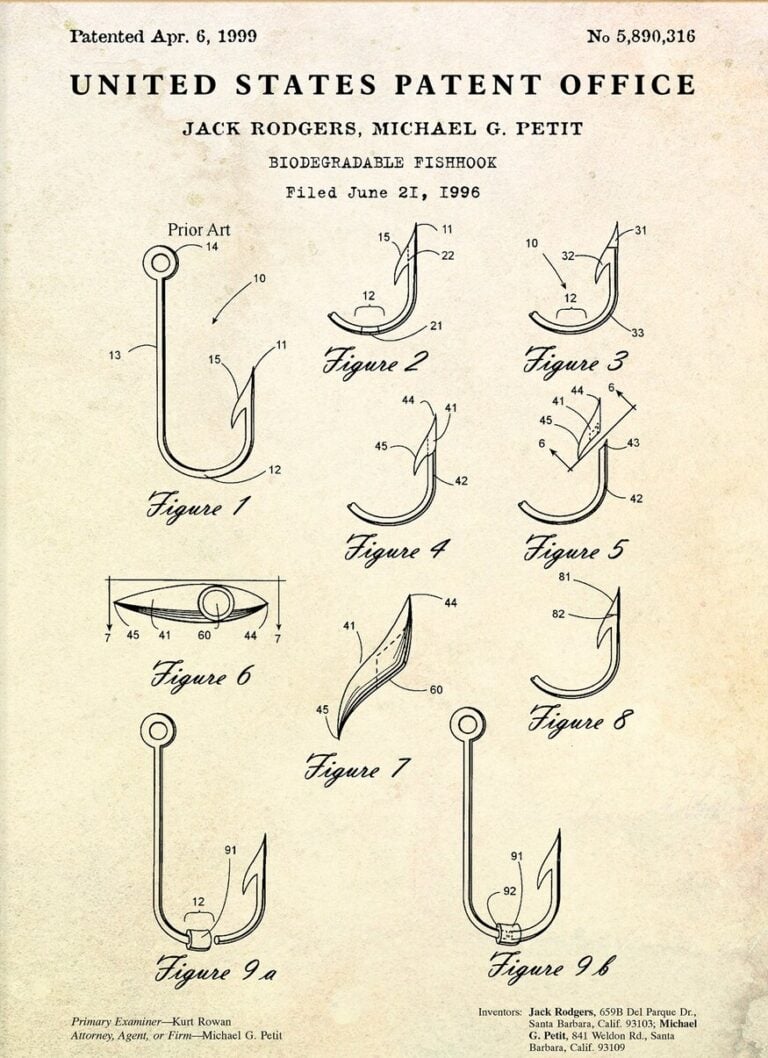
Historically focused on fishing and safety, marine innovation has now grown into a diverse ecosystem of sophisticated, sustainable technologies. With millions of global filings in such domains, identifying the right patent during prior art searches is like finding a pearl in the ocean. That is where patent intelligence becomes invaluable, transforming raw data into clear, strategic business insights.
The Intersection of Marine Tech and Patent Intelligence
Developing capital-intensive ocean technologies from autonomous data-buoys to wave-energy converters present incredibly high strategic and financial stakes. This is where the distinction between a basic Patent Search and comprehensive Patent Analytics becomes critical:
- Patent Search (The Microscope): Answers the question, “Has someone already invented this specific device?” It looks backward to ensure patentability or freedom to operate (FTO) and prevent immediate litigation.
- Patent Analytics (The Radar): Answers the question, “Where is the market heading, who are our future competitors, and where are the untapped technological white spaces?” It looks forward to guide corporate strategy.

How do enterprises successfully pioneer sustainable marine tech without hitting a wall of litigation or wasting millions on redundant R&D? The answer lies in Patent Analytics.
Driving Sustainable Innovation Through Patent Analytics
To celebrate World Oceans Day by driving actual commercial and environmental impact, enterprises must use patent data to make proactive, highly informed research and development decisions rather than viewing intellectual property as merely a legal necessity.
1. Identifying the “White Spaces” in Marine Tech
A deep-dive patent landscape report maps out global marine innovations to reveal exactly where a market is suffocatingly saturated and where it is completely wide open.
For instance, patent filings for an unmanned ocean vehicle US12377946B1, standard mechanical plastic removal ships-like the conveyor-belt systems seen in US11254397B1, or passive barrier systems like NL2019839B1 recognized inventions that are becoming densely clustered. However, a comprehensive landscape analysis might reveal a massive, unprotected gap in deep-sea autonomous microplastic detection algorithms. Patent analytics points research and development teams directly toward those uncrowded, highly abundant waters where a company can establish undisputed market dominance.
2. Competitive Intelligence: Mapping the Micro-Trends
Who is actively funding the next generation of automated marine cleanup? By analyzing patent filing velocity, geographical distributions, and assignee data, businesses can track competitors’ strategic pivots long before their products ever hit the commercial market.
If a primary competitor suddenly spikes their patent filings in advanced automated marine debris collection, like the technology detailed in US12077257B2, or autonomous oil spill recovery like US11401673B2, the business gets a critical advanced head start to respond, pivot, or out-engineer them.

3. De-Risking Mergers and Acquisitions (M&A) and Investment Decisions
When an enterprise is looking to acquire a green-tech startup or license an ocean-monitoring sensor array, basic corporate due diligence falls short. Patent intelligence thoroughly evaluates the quality, health, and defensibility of the target’s intellectual property portfolio.
Does their patent family have broad geographic coverage, similar to global ocean preservation leaders? Is their technology built on a proprietary, legally sound foundation, or is it highly vulnerable to invalidation by older prior art, even going as far back as early marine innovations like improved fish-hooks US13649A? Advanced analytics removes the guesswork from an investment portfolio.

The Trap of Hidden Cross-Industry Infringement in Modern Marine Tech
Today, the traditional maritime sector is transforming into a digital ecosystem. This is creating an entirely new generation of valuable environmental patents across technical pillars like high-scale ocean cleanup systems, deep-sea robotics, and species-selective fishing net systems (like CN111820194A or US10966415B2).
This transformation presents a unique hidden danger for modern innovators. Because modern marine innovation sits at the volatile intersection of aerospace (satellite tracking), automotive (autonomous drive algorithms), and heavy industrial manufacturing (corrosion-resistant materials), the prior art that could invalidate an invention often does not even live in a maritime database.
Consider how easily cross-sector overlaps occur in patent filings:
- The Autonomous Intersection: If an organization is developing an autonomous underwater vehicle to track marine debris, its navigation systems might inadvertently overlap with terrestrial vehicle lane-keeping algorithms or aerospace drone stability models. A patent for terrestrial LIDAR mapping could suddenly become devastating prior art for a maritime drone.
- The Kinetic Energy Confluence: Modern smart buoys, such as those tracking lost commercial nets, are increasingly engineered as self-powered systems. They harvest wave energy by integrating triboelectric nanogenerators; a technology heavily cross-patented in the consumer electronics and wearable medical patch industries.
- The Computer Vision Overlap: An AI-driven, species-selective net tracking system relies on computer vision software that frequently faces structural architectural overlap with automated object-sorting patents filed in automated retail fulfillment or waste management sectors.
Dense, multi-disciplinary prior art landscapes make traditional keyword searching completely blind to these cross-sector overlaps.
Conclusion
Our oceans cover 70% of our planet, offering an incredible frontier for blue-green innovation; but diving in blind is too risky. The global patent ecosystem is not just a static legal archive; it is a massive, dynamic ocean of innovation intelligence. In a hyper-competitive, innovation-driven economy, companies that deeply understand and leverage patent intelligence will inevitably lead the future. True strategic advantage comes from combining fast AI tools with human insight to map these complex landscapes. Outsourcing these research needs to specialized analytics partners ensures that sustainability initiatives are built with technical and legal certainty.
By leveraging MaxVal’s advanced patent search and analytics services, innovators can confidently dive deep into the ocean of patent data to uncover pearls of innovation that make proactive, highly informed R&D decisions possible. We break down industry silos, systematically scanning adjacent technology verticals to uncover hidden overlaps before they become costly legal battles. This hybrid intelligence empowers organizations to uncover hidden market opportunities, mitigate costly legal battles, and build dominant corporate strategies for the future.
Know Before You Go
1. Which patent databases does MaxVal use?
MaxVal taps into global authority databases including the USPTO (Patent Public Search), EPO (Espacenet), and WIPO (PATENTSCOPE), alongside elite data repositories integrated with AI-driven analytics, including Relecura, PatSnap, IPRally, and PatSeer.
2. What is MaxVal’s approach to non-patent literature (NPL) search?
MaxVal analysts conduct non-patent literature (NPL) searches across trusted sources such as ProQuest, Google Scholar, IEEE Xplore, 3GPP documents, Springer, and ScienceDirect and many more to identify prior art that goes beyond traditional patent databases.
3. How does MaxVal ensure a successful professional patent search?
MaxVal analysts conduct successful searches by combining deep technical insight and strategic classification logic with cross-database validation, using a hybrid approach that blends AI automation with human judgment and cross-domain tracking to uncover hidden prior art across diverse industry verticals.
4. What capabilities do advanced patent analytics platforms provide?
These advanced platforms utilize AI-driven tools to offer semantic searching, classification-based retrieval, intelligent feature mapping, and citation analytics, while keeping all information confidential and protected.
5. What are the risks of missing a critical patent reference?
Missing even a single prior art reference can lead to costly patent rejections, increase infringement risk, weaken licensing strength, and jeopardize high-value M&A decisions.