In order to keep a US patent in force, the US Patent & Trademark Office requires that patent owners make maintenance fees at years 3.5, 7.5 and 11.5 after grant. This is in addition to filing, search, examination and post-filing fees.
Other patent issuing authorities use different rules. For the European Patent Office (EPO), maintenance payments must be made annually and cannot be pre-paid. For Japan (JPO) and the Korean Intellectual Property Office (KIPO), fees are due annually and can be prepaid.If the patent owner decides not to pay the maintenance fee, then the patent owner loses the patent rights and the patent reverts to the public domain. If a patent is abandoned, the term of the patent is shortened and patent protection ends well before the maximum life of the patent. At MaxVal, we have compared abandonment rates for US, European, Japanese and Korean patents. Our goal is to see if abandonment rates differ between single year or multi-year renewal countries.
Key Takeaways
- The US requires payment at only three fixed points (3.5, 7.5, 11.5 years). About 50% of US patents are renewed through the full 20-year term.
- The EPO requires annual payments that cannot be prepaid. Only about 17% of EPO patents reached the full 20-year term in the data studied here.
- JPO and KIPO allow annual fees to be prepaid, and both retained a higher share of patents to full term than the EPO, though lower than the US.
- The pattern: the more a renewal scheme forces a fresh, annual pay-or-abandon decision, the more patents lapse early. Multi-year, prepayable, or lump-sum schemes
Analysis of Lapse Rates
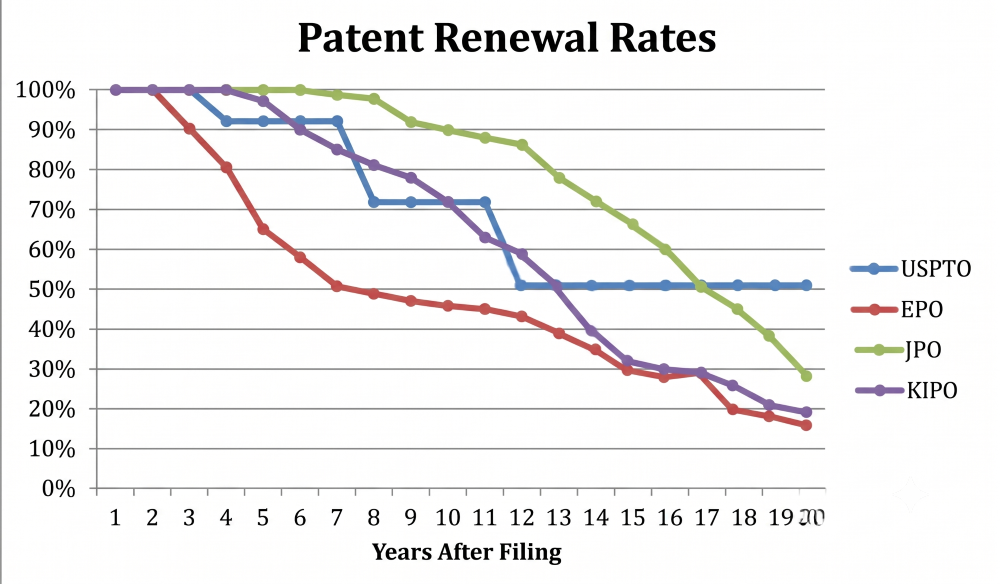
A good indicator of this could lie in the rates that patents lapse due to nonpayment of renewal fees. As seen in the graph below, different patent annuity systems yield different lapse rates.
Looking at the US – in 2014, 50.7% of active patents were renewed for the Third Stage (11.5 years). Since payment of the Third Stage gives those patents protection from years 12-20, it can be said that 50% of patents filed in the US are active for the full 20 years of the patent term.
This lapse rate is much different than in patent offices that require annual patent fees that cannot be paid in an advance lump sum like the EPO. In 2010, only 50% of active patents were renewed for the 8th year of the patent term. Only 42% of the patents are renewed beyond the 12th year of the patent term. Furthermore, only 33% of patents were renewed beyond the 15th year. Only about 17% of patents are active for the entire 20-year patent term. These statistics indicate that patent owners were very wary of paying higher annuity fees and were able to judge if the patent was economically viable on a yearly basis. This arguably led to a higher percentage of patents lapsing and entering the patent domain much earlier than in the US.
Additionally, patent offices that accept advanced lump sums of annual fees, like JPO and KIPO, have different renewal rates as well. At the JPO, the number of renewed patents only dropped to 50% after 17 years of the patent term. Also, 33% of patents were renewed throughout the 20-year patent term. At the KIPO, the number of renewed patents only dropped to 50% after 13 years of the patent term. However, the patent renewals drop to 33% after the 16th year of the patent term. These statistics indicate that, if allowed to, patent owners are more likely to pay their maintenance fees in advance, which would prevent the lapse of patents that are economically not viable.
| Office | Data Year | Drops to ~50% renewed at | Drops to ~33% renewed at | Active for full 20-year term |
| USPTO (US) | 2014 | Year 11.5 (Third Stage) | Not separately stated | ~50% |
| EPO | 2010 | Year 8 | Year 15 | ~17% |
| JPO | 2010 | Year 17 | Renewed throughout, ~33% at year 20 | ~33% |
| KIPO | 2010 | Year 13 | Year 16 | Not separately stated |
Conclusion: What This Means for Patent Owners
For patent owners, annual renewal schemes seem to offer greater flexibility for making renewal decisions. When fees are payable annually, patent owners have more control over what to keep than they do in the US system.
From the perspective of a patent office, it would appear that forcing patent owners to make multi-year commitments increases renewal income. So, a multi-year scheme is beneficial for the patent office.
Owners of US patents should take care at the Third Stage. The data suggests that some patents that are routinely renewed at 11.5 years should be considered for abandonment. Those patents would be soon abandoned under an annual renewal scheme – but that option is not available in the US.
*Sources:
MaxVal offers IP renewal services to help companies plan and execute fee payments across all of these renewal schemes.
For a fuller framework on evaluating renewal costs and risk across jurisdictions, see MaxVal’s guide to patent renewal management, or request a demo to see how Symphony’s renewal management works across all four of these office types.
Frequently Asked Questions
Why do more US patents stay in force for the full 20-year term than EPO patents?
The US only requires maintenance fee payments at three fixed points (3.5, 7.5, and 11.5 years), while the EPO requires annual payments that cannot be prepaid. That yearly pay-or-abandon decision at the EPO appears to lead more patent owners to let low-value patents lapse earlier.
What is a multi-year renewal scheme?
A multi-year renewal scheme, like the US system, groups maintenance fee decisions into a small number of fixed milestones rather than requiring a payment every year. This reduces the frequency of abandonment decisions and is associated with higher rates of patents reaching full term.
Can patent renewal fees be prepaid?
It depends on the office. The EPO does not allow prepayment, annual fees must be paid as they come due. JPO and KIPO both allow annual fees to be prepaid in advance, which the data suggests leads more owners to commit early rather than reassess every year.
Does MaxVal offer patent renewal management services?
Yes. MaxVal’s IP renewal services (branded MaRS) manage patent and trademark renewals globally, and renewal management is also built into MaxVal’s Symphony platform.